
Iran Thoughts

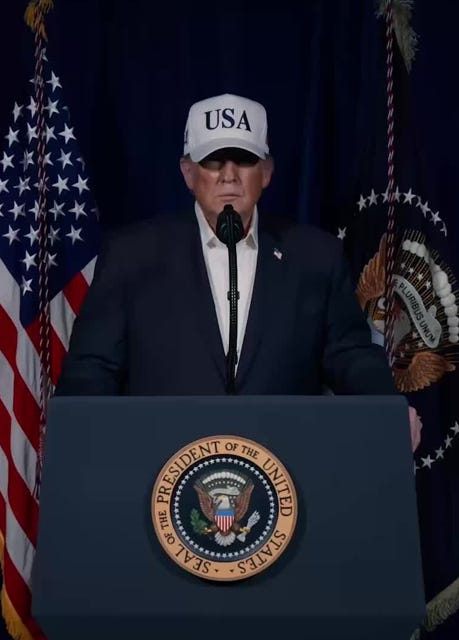
I woke up this morning and my wife informed me that we were at war with Iran, and my response was “why?” That’s a bad sign. When your country undertakes major combat operations against another country, ideally the reasons for killing other people and (heaven forbid) allowing our servicemembers to be killed themselves won’t remain ambiguous. “Because they attacked our naval base at Pearl Harbor and killed a bunch of Americans,” “because the Third Reich declared war on us,” “because the Soviets invaded West Berlin,” “to liberate Kuwait,” “because the Russians attacked Estonia.” Something like these real or imagined justifications is what you want. As far as I can tell from listening to our addled commander-in-chief and our Fox News Weekend host Secretary of Pull-Ups and Make-Up, we are currently at war because: we need to obliterate the already obliterated Iranian nuclear program; we need to save face after the president ‘tweeted’ something about not killing protestors last month and did not like the Obama ‘red line’ comparisons; something about ballistic missiles; something about Israel? I’m really not trying to be glib or funny here. I despise the mullahs and the Islamic Republic, and I’ve been a hawk on Iran for as long as I’ve followed this stuff, but as the bombs fall, I feel a strange mixture of sadness and anger about how this is all going down. So, some scattered thoughts:
1-The republic truly is dead. The American republic, I mean. Since election night 2024, I have seen clearly that the man who sent a mob to attack the first branch of government would govern like a king, and I was right. I’ve written this type of thing so many times and said it in person to so many people but, I’m sorry, it’s the great story of our time: for all intents and purposes, we live under an elected (for now) monarch who makes tax, spending, and war decisions on his own by executive fiat and completely disregards Congress because he feels confident that no one will hold him to account.
Sure, moments still arise when this experiment in self-government shows a pulse, such as when the courts try to explain to the president that he should listen to the legislature with regard to trade policy, and try to tell the legislature that maybe they should, you know, pass laws and conduct oversight with regard to trade policy. But lawyers always find another loophole to push the envelope again, and we return to a world where the executive just does what he wants, basically.
I understand that we sometimes need energy in the executive, and sometimes bad guys in Waziristan need droning, and of course we can defend treaty allies (treaties, remember, that the Senate ratified) without holding a public congressional debate. But when leaders carry out a major weeks-long military build-up followed by a major regime-change war against a country on the other side of the world, the mothers and fathers of our pilots, speaking through their elected representatives, should have a say in this, as well as the construction workers and plumbers who, let’s remember, will ultimately pay taxes for this.
I can write a book about this, but Congress is supposed to sit at the center of our government, and we basically do not have one. A decadent people elected a bunch of decadent congressmen and congresswomen and then layered a decadent, corrupt, and unserious game show host on top of all that, and now we reap the whirlwind. I say it’s dead, but I still hold out hope that we can resurrect it.
2-Wars go sideways, and war is the great teacher. Don’t listen to anyone who tells you that “the boys will be home by Christmas,” because they almost never are. Obviously that is a WWI reference, but no war plan survives first contact with the enemy. Even when things look clean and neat, enemy statues come down, and the president stands in front of a stupid “Mission Accomplished” banner, the enemy still tries to kill our guys.
Pure air power wars never work. As I’ve written before, even in our advanced technological age, you need boots on the ground (or at least a credible threat of boots on the ground) to accomplish big political objectives. Hell, we basically lost the war against the Houthis last year because they refused to cooperate and stay still while our navy played whack-a-mole in Yemen. As the Blitz showed, pure air campaigns tend to strengthen resolve. And although we must make educated guesses, we still cannot know who is a paper tiger and who is actually dangerous until the fighting starts. I, along with most people, thought that the Russians would roll easily into Kiev and conquer Ukraine in 2022, and I was dead wrong. I failed to appreciate how much work Ukraine had done after the 2014 invasion and later annexation of Crimea. War focuses the mind, and its brutal logic weeds out weak commanders, weak tactics, weak supply lines, etc.
I think Iran is probably still as weak as they proved last year, but who knows? To my eye, they are not launching massive, poorly planned salvos at Israel or our troops. Maybe they learned lessons, moved assets, and thought long and hard about how to sink ships and down planes. Since February 2022, events have laid bare the sorry state of America’s defense industrial base. How long until we start to run out of missiles and interceptors, and can we replace them?
In the meantime, what does that do to our other obligations in other parts of the world, such as our (theoretical) NATO commitments or our commitments to Japan? Are we tying our hands with regard to our Taiwan options? It sure would be nice if we had an elected body of representatives who would ask these questions and debate their answers.
3-What is the endgame? I’m sorry for all of these question marks, but this entire war is one big question mark. Let’s say we kill the Ayatollah—does that count as regime change, even if the structures of the Islamic Republic remain intact? What if those structures collapse but the IRGC installs a military dictatorship? Again, we couldn’t even defeat the tiny Houthis in tiny Yemen, so are Marines going to take helicopters into Tehran or Qom to deal with this state-within-a-state? I love the idea of the great Iranian people rising up to overthrow these religious fanatics who have only brought them misery since 1979—but they tried that a few weeks ago (at our irresponsible insistence), and maybe 20,000 of them died. And besides, they most likely will not take to the streets if a weeks-long violent bombing campaign unfolds all around them (unless some credible Kurdish-like military force waits in the wings and I just don’t know about it).
If I were a young father in Tehran right now, I’d probably try to get to Turkey or Europe before the Syrian civil war restarted in my backyard. And let’s not forget that Iran is very much a multi-ethnic society. Even the Ayatollah’s father was an Azeri, not Persian. Refugee crises tend to become problems not just for the neighborhood but for the world at large. Syrian refugees in Europe about a decade ago led directly to the AfD and might lead to a Le Pen presidency in France (if the courts allow it). Iraq’s democracy and economy seem to function alright at the moment, and Turkey’s economy and pseudo-democracy have struggled for a long time now. I can’t imagine that an influx of desperate Iranians to Ankara or Baghdad will help those places. And for all the happy talk about the Shah, he was very much a son of a bitch, too (though he was ours, of course). If someone brings his basically American dimwitted son to Iran on an Israeli or American plane, people will quickly remember his father’s tyranny and secret police force.
4-I don’t think this will go well for Trump. The most important thing this morning is the lives of our servicemembers, Americans in the region, and, yes, civilians of every country (including Iran). War always produces civilian casualties, and this one will be no exception. But when I step back and think about my biggest concern—the re-founding and strengthening of American democracy—I think this will undermine the president’s political standing and his anti-liberal project. His dismal poll numbers do not sit in the twenties because overwhelming majorities of Republicans still support him, but they didn’t sign up for a major Middle Eastern war that appeared out of nowhere (from their point of view). Like Bush in 2005 pushing Social Security reform after saying nothing about it, Trump has over the past year pushed a number of things completely different from what these (misguided) Trump voters wanted: “make our cultural enemies cry and please fix the economy.” Of course most of the right-wing courtiers and court jesters will twist themselves into knots to justify and support whatever their God King does—but not all of them will, especially the straight-up Israel haters. And even if the right-wing infotainment juggernaut goes into hyperdrive to make our small-man president look like a big, strong war leader, more and more conservative supporters will slowly realize that Trump really isn’t concerned with them or with improving their lives.
Who knew.
This is a deeply thoughtful and well written post by Michael Wood. He is spot on about the military strike, and also what it says about our nation's system of government with Trump running roughshod over all branches of our democratic republic.
So much for our 250th anniversary.